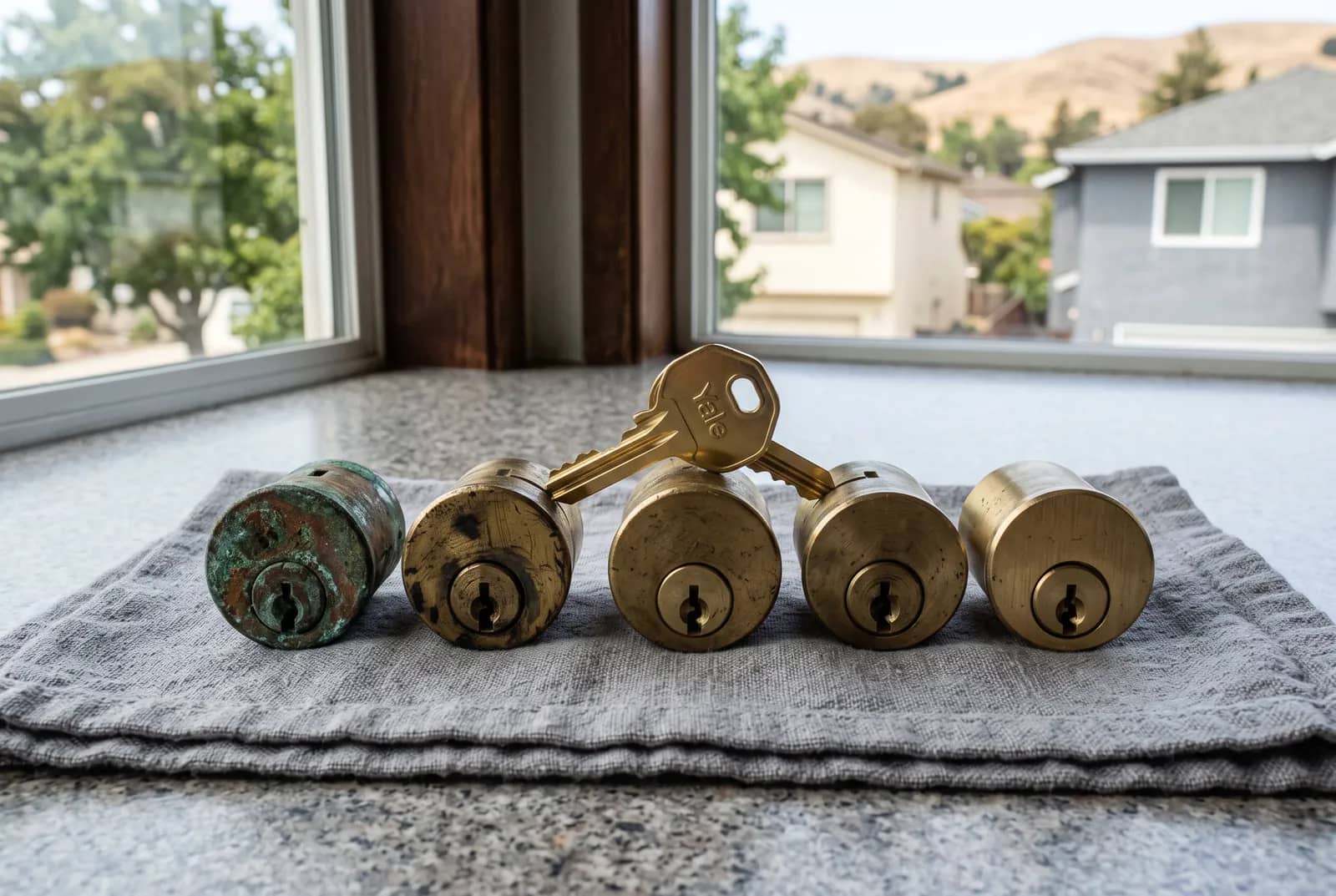
Count cylinders, not doors
The first thing said on the call is a number, and it is not the number of doors. A front door with a keyed knob and a deadbolt above it is two cylinders on one door. A typical house here comes to five: the front knob, the front deadbolt, the back door, the side door of the garage, and a gate or a shed padlock. Some have six with a mailbox at the curb that nobody has opened in a decade.
Nobody chose that arrangement. The locks arrived at different times, from a builder, then an owner in 1978, then an owner in 2004, and each one brought a key of its own. What is on your ring is the history of the house rather than a decision anybody made.
What actually happens inside the lock
The cylinder comes off the door, or the plug comes out of it with a follower so the top pins and springs stay where they are. The old bottom pins drop out. New ones are chosen to a fresh combination and dropped in, the plug goes back, and a key is cut to match. On a familiar lock it is a few minutes once the first one has set the pattern.
Nothing is bought. The knob, the deadbolt, the rose, the finish and the scratches all stay exactly as they were. From the outside the door has not changed at all, which on a house where the hardware matches the year it was built is the entire point. What has changed is that the key in the drawer of whoever lived here before does nothing.
The limit nobody explains: keyways
One key can only open cylinders that accept the same blank. A Kwikset key and a Schlage key are different shapes in cross-section, and no amount of repinning will make one enter the other. A house with a Kwikset knob on the front and a Schlage deadbolt above it cannot go on a single key until one of those two cylinders is changed for one of the other family.
That swap is a small part and a few minutes of work, and it is one of the things that moves a job from the $29 end of the range to the $47 end. It is worth two minutes on the call: the brand is stamped on the face of almost every lock, right around the keyhole. Read five names down the phone and the figure that comes back is close to final rather than a guess.
What one key does not do
It does not upgrade the lock. A builder-grade knob with new pins in it is still a builder-grade knob, and if it could be turned with a screwdriver last week it still can. Rekeying answers who holds a working key. It does not answer how strong the door is.
It does not rescue a worn cylinder. New pins in a plug that has done seventy years give you a lock that turns badly with a different key instead of turning badly with the old one. Where that is what is on the door you will hear it, with a replacement priced against the published $129 to $339 rather than folded quietly into the bill.
And it does not touch codes. A keypad's codes are changed separately and take a couple of minutes each; a keypad's cylinder, on the other hand, can usually join the house key, which is worth doing while the lock is off the door.
When it is worth doing
When you buy. Every key that passed through an agent, a stager, an inspector and two contractors still works until the pins change, and nobody can tell you how many exist.
When a tenancy turns over. About 39 percent of the occupied homes in this city are rented, so this is the commonest reason we are called out on an ordinary Tuesday. Between leases it is a short visit, and it is far cheaper than the alternative of new hardware on every door once a year.
When a remodel ends and the contractor's key box has been hanging on the gate for four months. When a ring goes missing at a trailhead. And when a household has simply lost count of the copies, which is the most honest reason of the four and the one people are most reluctant to say out loud. It is arithmetic, not a confession.
What the visit costs, and two habits worth insisting on
It is $29 to $47 per cylinder, with the second and third at the low end because the van is already at the curb, and the $89 service call counted once for the stop rather than once per lock. Five cylinders together therefore cost a fraction of five separate visits. Between 8pm and midnight the figure carries $55 and after midnight $95, said on the call. Ninety days on the labor, written on the receipt.
The first habit: count the copies you are handed and write down which one went to whom. Five doors on one key is only tidy for as long as you know where the keys are, and the note takes thirty seconds. The second: before the receipt is signed, walk the house with the new key and lock and unlock every door from both sides while the technician is still standing there. That is what separates a job that is finished from one that is merely over.
Quick answers
Is rekeying the same as changing the locks?+
No. Rekeying changes the pins inside the cylinder you already own, at $29 to $47 each, and the hardware stays on the door. Replacing a lock is $129 to $339 and is for a lock that has failed, not for one that has changed hands.
Can a Kwikset and a Schlage go on the same key?+
Not as they stand, because the key blanks are different shapes. One of the two cylinders is swapped for the other family, which is a small part and a few minutes, and it is the usual reason a cylinder is priced at the $47 end rather than the $29 end.
How long does five cylinders take?+
Usually under an hour once the first one has set the pattern, plus a few minutes for cutting and testing keys. The $89 visit is counted once for the stop however many cylinders are on the list.
Need it handled rather than read about?
(669) 274-3850