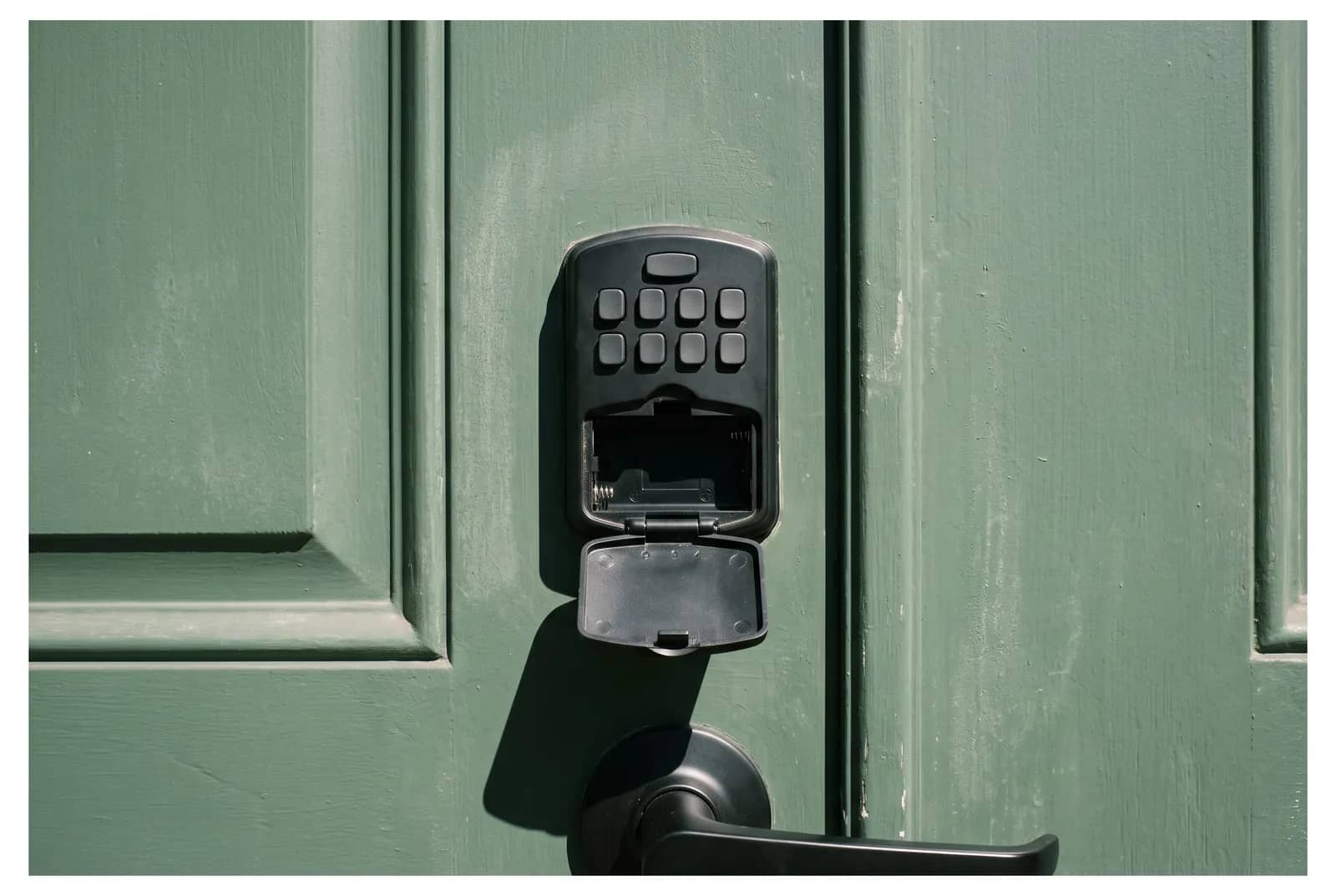
The lock tells you, and then it stops telling you
Almost every keypad deadbolt warns before it quits. A red flash on the keypad after a correct code, three short tones instead of one, a line in an app that nobody has opened since the week it was installed. That warning typically runs for two to three weeks of ordinary use, which is generous, and which is exactly why it gets ignored.
When it finally stops, it stops without ceremony. The keypad does not light. The code does nothing. There is no sound and no message, because there is nothing left to make one with. That is the moment the mechanical key stops being a formality.
What actually kills the cells
Heat is the quiet one. A west-facing door in August takes several hours of direct afternoon sun, and the housing on the outside of the door gets considerably warmer than the air. Alkaline cells lose output when they are cooked and then cooled, day after day, through a summer. Doors under a deep overhang go a year on a set; the same lock on an unshaded west door can want changing twice.
Then the small mistakes. Mixing an old cell with three new ones drags all four down to the old one. Rechargeable AA cells are 1.2 volts nominal against 1.5 for alkaline, so a lock reads a healthy pack as nearly flat and starts warning immediately. And lithium cells last longer in heat but not every lock's low-battery threshold is set for their discharge curve, so the warning can arrive very late.
The largest drain is not a battery problem at all. A motor pushing a bolt into a strike it does not quite meet draws several times the current of one running free. A keypad that eats a set of cells every two months almost always has a door that has dropped on its hinges, and the cure is three-inch screws and a re-cut strike pocket rather than another four-pack.
The key that came in the bag
Most keypad deadbolts have a keyway, usually under a cover on the face or on the underside of the housing, and most ship with two cut keys in the box. Three things happen to those keys, and all three are discovered after dark. They were never taken out of the bag and the bag is in a drawer in the garage. The lock came with the house and the keys went with the people who left. Or the cylinder was rekeyed to the house key at some point and the keys in the box no longer fit it.
None of that is unusual and none of it is anyone's fault. It is simply the one part of a lock that has no way to remind you it exists. The keypad tells you when it is unwell. The keyway says nothing at all until the day it is the only thing left.
Cutting it and testing it in daylight
A key for a keypad deadbolt is cut at the van in a few minutes, and the sensible time is while a technician is already at the house for something else. The test is not that a key exists. The test is that it goes in without persuasion and turns the bolt the whole way, both directions, with the door shut. A key that opens the lock on the bench and binds in the door has not been tested.
Then decide where it lives. Not on the ring you are holding when the door shuts behind you. A neighbor on the same street is the best answer in a city where people are home at different hours. A decent lock box, out of sight and screwed to something solid, is the next best. The glove box of the car that stays home is a reasonable third.
While the cylinder is off, it is worth putting it on the same key as the rest of the house at $29 to $47. An emergency key you already carry for the back door is a far better emergency key than a stranger on a hook in the garage.
Locks with no keyway at all
Some models have no mechanical override. Manufacturers offer two contacts under the housing that take a nine-volt battery held against them for long enough to run the motor, and that works when the contacts are clean, when you have a nine-volt battery in the house, and when the door is not binding. Those are three conditions, and outdoors on a door that has weathered a few winters the contacts are the one most likely to fail.
If that is the lock on your door, decide the plan now rather than at eleven at night. Either a second exterior door that opens with an ordinary key and a key kept off the property, or a lock box holding that key, or a different lock. Any of the three is a fine answer. Having none of them is the arrangement that ends in a call.
The night version and the daylight version
A house lockout is $135 to $245 with the $89 service call already inside the figure. Between 8pm and midnight the figure carries $55 and after midnight it carries $95, counted on the call so the number you hear is the number on the receipt. Nothing is added at the door for a second attempt or an awkward approach.
A key cut on a visit you were already having costs a small fraction of that, and it is the least interesting recommendation on this site. Worth adding: a keypad deadbolt is often slower to open than a plain one, because the cylinder is small, shrouded by the housing and set at an angle that suits the designer rather than a technician on a doorstep. We would very much rather cut you a key in March.
Quick answers
How long do the batteries in a keypad deadbolt last?+
Six months to a year on a sheltered door, and less on a west-facing one that takes the full afternoon. Change them on a date you choose rather than on the date the lock chooses, and change all four at once from the same pack.
My keypad eats batteries. Is the lock faulty?+
Usually not. A bolt that meets the edge of the strike instead of the middle makes the motor work several times as hard. Three-inch hinge screws and a re-cut strike pocket normally end it, and both are part of a visit rather than a purchase.
Can the keypad's key be the same as my other doors?+
In most cases yes. The cylinder is rekeyed to the house key at $29 to $47, so the spare you already carry opens the keypad door when its batteries are flat. It is done while the lock is off the door.
Need it handled rather than read about?
(669) 274-3850